


Where is the best place to play poker?
Game Theory and Poker
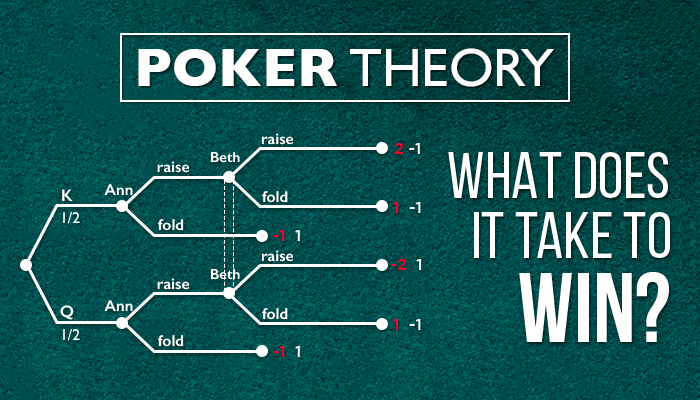
John Nash developed game theory as a branch of mathematics at Princeton University around 1950. Over 15 years, poker became very popular, and players reached an extremely high skill level. At such a level, it is very difficult to be a good player and win without the help of game theory.
Mathematical understanding made the game much deeper and more complex. Based on game theory, you have to consider all decisions from each opening from different positions to seemingly insignificant check on the river when playing for a small pot. Every decision determines how much you win and lose (win rate) as a poker player. These things are measured by the value we expect or EV (expected value). If your decision is profitable, it is EV+, if not – EV-.
A very simple example of applying game theory is a player using a specific opening range from the UTG position.
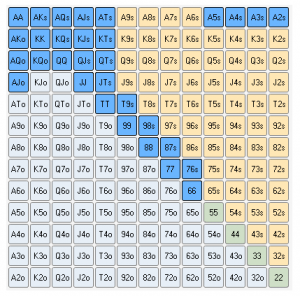
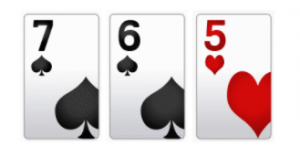
Of course, it is obvious that playing very strong hands by opening from UTG is a profitable decision, but if we only played with the strongest hands, we would be very predictable. By opening hands like 9s8s or 66, we balance our opening range and make the game more difficult for our opponents. This way, we can gather a strong combination regardless of whether high, low, or medium cards are revealed on the table.
For example, the cards we mentioned earlier would fit:
Why use GTO (game theory optimal)?
You might be wondering why this theory is needed if most of the money comes from exploiting the weaknesses of poorer players?
Here are two main reasons:
- By using GTO, you will win money in the long run regardless of whether you are playing against weak or more skilled players
- It is much easier to adapt and change your strategy based on opponents when you have some foundation from which you deviate one way or another depending on the opponent
If you look at the game through the prism of GTO, you can review your played hands and determine what the most optimal decision would be, thus allowing you to evaluate your game more objectively. This perspective gives you the opportunity to understand if you are balancing your range.
Moreover, you analyze not only one specific situation where specific two cards are dealt but also generally gain an understanding of how to play in such a situation with all other cards.
If in one situation you make a value bet, your range must also include cards with which you would bluff in the same spot, so your opponent can never be sure whether you are bluffing or have a strong combination.
If you only bet on the river when you have a strong hand, the opponent can always profitably fold because they know you never bluff in such a situation. On the other hand, if you bluff too often in such situations, the opponent can always profitably call because they know you almost never have a strong combination.
If you still don't think a GTO-based strategy is the way to go, these hypothetical Doug Polk examples should help.
Poker Theory, Examples
On the river, you bet $100 into a $100 pot, so your opponent needs to call $100 to win a $200 pot. This means your opponent has 2 to 1 pot odds and needs to win at least 33% of the time to break even.
This short calculation shows the optimal bluffing proportion in your range when betting on the river card. So, 33% means that one out of three times you will bluff, and two times you will bet for value. This frequency is optimal because you will usually win the pot and not risk being figured out.
Let's look at 4 different scenarios of value betting and bluffing ratios to understand why a range with 33% bluffs and 67% value bets is optimal and why your opponents can't do anything against you.
To simplify the scenarios, let's imagine that we always win when the opponent calls our value bet and always lose when they call a bluff.
Scenario 1 – 0% bluff, 100% value bet
Your opponent can fold 100% of the time. In your results, this will reflect as winning $100 with your betting range.
Scenario 2 – 100% bluff, 0% value bet
Your opponent can call 100% of the time. In your results, this will reflect as losing $100 with your betting range.
Scenario 3 – 50% bluff, 50% value bet
If your opponent calls 100% of the time, you will win $200 every time you bet for value and lose $100 when you bluff. In your results, this will reflect as winning $50 if the opponent always calls. (50% * -$100 = -$50; 50% * $200 = $100. $100 – $50 = $50).
If the opponent always folds, you will win $100 (same as in the first scenario)
This scenario shows that not bluffing at all is as profitable as bluffing 50% of the time.
Scenario 3 – 33% bluff, 67% value bet
If your opponent always calls, you win $200 when you bet for value and lose $100 every time you bluff. In this case, you lose $100 only 33% of the time and win $200 67% of the time, meaning your profit is $100. (33% * $100 = -$33; 67% * $200 = $133. $133 – $33 = $100).
This ratio of bluffs and value bets is optimal because:
- You win $100 if your opponent always calls
- You win $100 if your opponent always folds
So, you earn $100 regardless of what your opponent does. Of course, this win-win scenario is only possible when your range is perfectly balanced. Therefore, it doesn't matter what your opponent chooses, as you earn the same in both cases.
Applying such a balance considering opponents' mistakes and weaknesses can be even more profitable, but it requires reliable information about the opponent and correct application. If you want to move up the limits and crush opponents in the long run, GTO is essential.
4 reasons why this strategy is worth using
Let's review the benefits of GTO in our strategy, 4 things you will achieve by incorporating this theory into your game.
Avoid illogical thinking
The legacy of 90's poker training – trying to understand what level a player is playing at.
- The level where a player only thinks about their own hand
- Then they start considering what the opponent might have
- The next level – thinking about what the opponent thinks about your cards
- Then it starts thinking about what you think the opponent thinks you have
- And so on.
Ideally, you somehow figure out where the thinking ends, determine what level the opponent is at, and adapt accordingly. But reality is different, and determining the level when playing against a weak player is very unreliable.
And against good and experienced players, this process can theoretically continue until the end of the world, until someone outthinks the other.
I would never question Patrik Antonius's poker skills, but such situations can be avoided by basing your bluffing strategy on GTO, which helps avoid level wars that cause confusion and lead to situations where you bluff without equity.
Avoid false assumptions
Another advantage – when you look at the game through the GTO lens, you avoid false assumptions about other players. Of course, some assumptions are possible if you have more than enough hands played against a specific player, but very general assumptions can be costly.
For example, it wouldn't be wise to say “there will NEVER be a bluff here” or “he will ALWAYS bluff here.” You also shouldn't think that an unknown opponent can't have a specific hand in their range or that they open very narrowly or very widely.
A well-structured GTO strategy removes confusion from your game and helps you play profitable poker in the long run.
Objective analysis
Most players judge themselves for playing a hand poorly just because they didn't win it. However, as you progress and advance in your poker career, you begin to understand that poker is not a business where results can be evaluated in a vacuum.
Thinking objectively can be very difficult, especially when the result of a played hand is very bad or very good. Just because you caught a full house on the river and won a lot of chips from your opponent doesn't mean calling the opponent's bet twice was a good play.
When you determine what decision is most profitable according to GTO in a specific situation, include the hand in your session analysis to find out if you made a long-term profitable decision not with a specific hand, but with your range.
All successful poker players know that admitting your own mistakes is essential if you want to play well. GTO provides the foundation that helps you spot mistakes much more easily.
Simpler adaptation
Why is theory important when trying to adapt to other players? To make it simpler, let's play a game.
Imagine you forgot everything you knew about poker strategy, except for the basic knowledge of the game, and you are playing your first hand in your life.
Live game, blinds $1/$2, effective stack $200.
The hero gets Ad9d and is in the BB position. Everyone folds to BTN, BTN raises to $7. SB folds, the hero calls.
Flop (pot $14) As Td 3h
The hero checks, BTN bets $9, the hero calls.
Turn (pot $32) Jc
The hero checks, BTN bets $21, the hero calls.
River (pot $74) 9c
The hero checks, BTN bets $50, the hero calls.
BTN shows Ah 2c. The hero wins $174 with two pairs.
What will you do next time you face this player in such a situation, how can you change your game to exploit the opponent's weakness? Without any theoretical understanding of this situation, you won't know where to start.
On the other hand, if you know how to theoretically best play with A2o in the BTN position, you will also know how your opponent deviated from that. This knowledge simplifies the path to adapting to this opponent.
Here are specific changes we can make to crush the opponent's aggressive thin value strategy.
- Small exploitation. Call the opponent's bets more widely (with weaker combinations than usual) on all streets when they make bets. (don't overdo it)
- Large exploitation. Ruthlessly attack their checking range when they are obviously very weak, with large bets both with thin value and a reasonable amount of bluffs.
Very often, understanding the theory of optimal play helps to more easily exploit opponents' weaknesses because you know exactly where your opponent's decisions deviate from optimal play. When you don't know what's good, it's almost impossible to understand what's bad.
Let's summarize
The pursuit of a perfect GTO strategy might seem like a logical conclusion, but the truth is that no one can play perfectly according to this theory. Poker will eventually be solved by a human or a machine, but we still recommend basing your game on this theory as much as possible. As always, this means you have to work on your game both while playing and during off-game hours.
This article only summarizes the basic principles of game theory applied in poker, but we hope that even from this you have gained something useful or at least awakened a sense of curiosity – how to enrich your game by applying game theory.