



Key points to know
- The tournament has been expanded to 48 teams for the first time in its history.
- the 12 groups of 4 teams keep the familiar structure.
- 32 teams will qualify for the play-offs – a new round of 32 has been added.
- A total of 104 matches will be played over six weeks.
- The tournament runs from 11 June to 19 July.
- The hosts are the USA, Canada and Mexico, with matches in 16 cities.
- The new rules are designed to speed up the pace of play and improve the quality of refereeing.
FIFA World Cup 2026 expanded to 48 teams
The most obvious change is the increase in the number of participating teams from 32 to 48. This opens the door for more countries to enter the tournament, especially from Africa, Asia and North America.
The new format brings together a wider mix of playing styles, making the group stage less predictable than before. For the traditional football powers, preparation becomes more challenging – meeting unfamiliar opponents in early matches adds an extra layer that was not there before.
The full list of participants and group line-ups can be found in the FIFA World Cup 2026 Participant Overview.
Three hosts and 16 cities
For the first time, the tournament will be hosted by three countries: the United States, Canada and Mexico. FIFA has confirmed that the games will be played in 16 cities – 11 in the USA, three in Mexico and two in Canada.
With such a wide geographical spread, travel becomes a separate part of the tournament. Teams will have to manage longer distances between matches, which will affect the recovery process and tactical preparation. For a detailed schedule of matches by date, please see the FIFA World Cup 2026 schedule article.
Changes to the qualifiers sistema
FIFA has officially confirmed the new allocation of qualification places between the confederations. The table below shows the number of places each association from each football region of the world receives.
| Confederation | Region | Number of places |
|---|---|---|
| UEFA | Europe | 16 |
| CAF | Africa | 9 |
| AFC | Asia | 8 |
| CONMEBOL | South America | 6 |
| CONCACAF | North and Central America | 6 (including 3 host countries) |
| OFC | Oceania | 1 direct |
| Intercontinental selection | – | 2 additional |
Oceania is guaranteed a place in the tournament for the first time. Meanwhile, the Intercontinental Qualifiers sistema open an additional pathway for teams that managed to finish just below the threshold in their regions.
New rules for the 2026 tournament
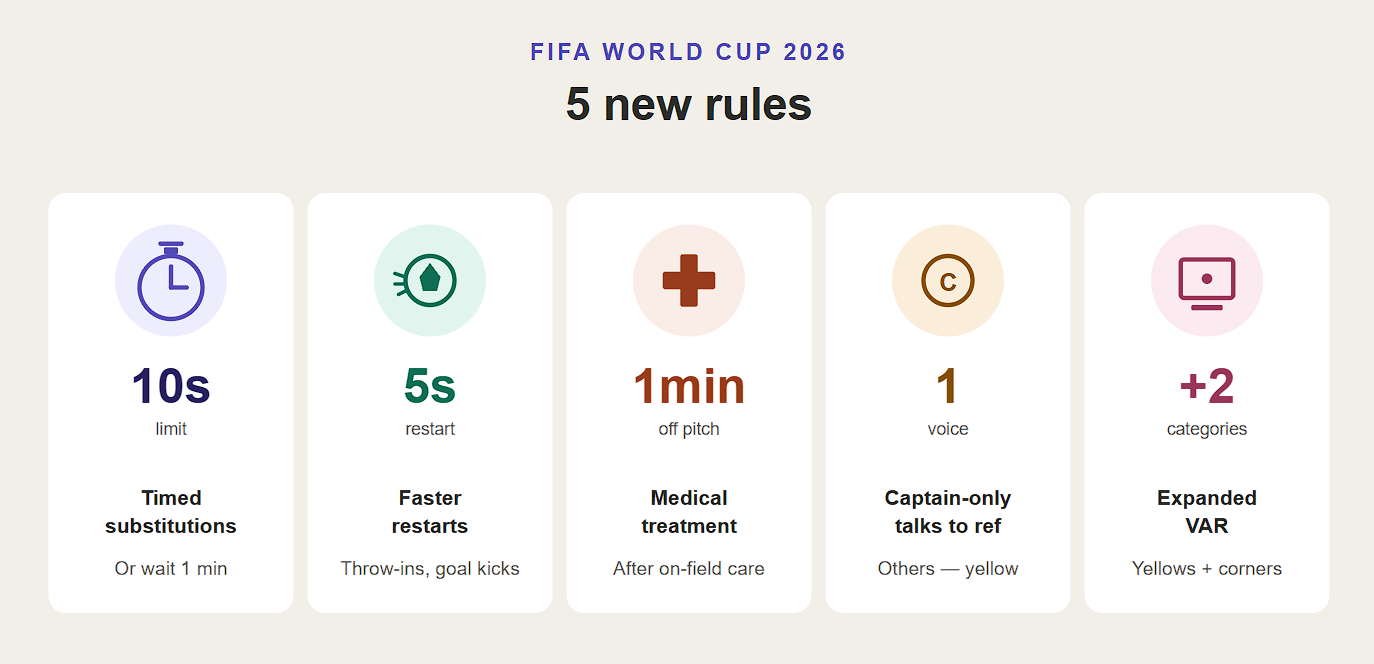
In addition to changing the structure of the tournament, FIFA will also try a number of rule changes designed to improve the pace of play and reduce time drags. We look at each of them in more detail below. More details on the official changes can be found via FIFA's official 2026 tournament page.
Time-limited changes
A player leaving the pitch will now have just 10 seconds to do so. If it takes longer, the substitute will have to wait another full minute, during which time the team will play with one less player.
This threat of punishment should naturally discourage players from stalling during substitutions. This is especially important in the final minutes of the match when teams are leading the score and trying to “stifle” the pace.
Faster game updates
Goal and scoring updates will now be limited to five seconds. If the ball is not put back in play within that time, the opponents will take control.
This change should speed up the pace of the match and eliminate unnecessary delays. Teams will need to practice standard situations even more accurately in order to react within the time limit.
Medical aid rules
Players receiving medical attention on the pitch will be required to leave the boundaries of the pitch and remain off the pitch for at least one minute before returning. The only exception to this rule is if the injury was caused by a foul for which a card was awarded.
This change should reduce unnecessary interruptions during the match and prevent tactical time delays. In the past, the frequent “quick recoveries” after medical treatment have been a useful tool for many coaches to slow down the pace.
Only the captain communicates with the referee
Only the team captain will be able to contact the referee. Other players will risk an immediate yellow card for intervening.
The aim is to reduce the pressure on referees and to prevent rallying around them after controversial decisions. Such scenes have become a common sight at recent tournaments, and FIFA has adopted a tougher approach.
Extended VAR powers
VAR sistema will now be able to review second yellow cards leading to sending off as well as incorrectly awarded corners. This gives referees additional support at crucial moments when a decision could determine the outcome of a match.
Previously, VAR was limited to specific categories (goals, penalties, red cards, mistakes of identity). The new rules mean that protocol decisions will change in a number of markets – especially in betting, where the markets for corners and yellow cards will become more important than before.
What the 2026 FIFA World Cup will look like
the 2026 FIFA World Cup is not simply an expanded version of the previous format. More teams means more variety, but also more unpredictability.
With a wider range of participants and a larger number of matches, maintaining consistency becomes more difficult even for the strongest teams. This can be seen in the bookmakers' odds – even the main favourite , Spain, has odds of 5.60 for the title at the 2026 World Cup, which is high enough for a tournament with no history of major surprises.
The rule changes should speed up the game and reduce interruptions, potentially leading to a more consistent pace throughout the match. Meanwhile, the title is to be defended by Argentina at the 2026 World Cup, which has odds of 9.20, while the third main contender, France at the 2026 World Cup, starts with odds of 6.60.
Travel, recovery and decision-making will play a bigger role than ever in the matches. In a tournament of this magnitude, small details will become more important than ever.
What the changes mean for betting markets
The new rules will also indirectly affect betting markets. The faster pace theoretically increases the average number of goals scored per match, which may make over under betting more interesting. Meanwhile, the captain's communication rule and the expanded VAR should mean that card markets will become less predictable in the early rounds.
When choosing a platform for the crucial group matches, it is worth comparing the best bookmakers in terms of in-play markets on offer.
Responsible betting on the six-week tournament
The World Cup lasts almost six weeks, with matches taking place almost every day. This pace increases the risk of chasing losses or betting just for fun. For practical advice on how to stay disciplined, please refer to the Responsible Gambling Guide.
FAQs on the FIFA World Cup 2026 changes
How many teams will play in the 2026 FIFA World Cup
The tournament will feature 48 national teams – the largest World Cup tournament in history.
What is the format of the FIFA World Cup 2026
The tournament will consist of 12 groups of 4 teams. The top two teams from each group will qualify for the play-offs, along with the top 8 third-placed teams.
Whether a new play-off round has been added
Yes, a round of 32 has been added. This means that teams will need to win one more game to reach the final.
How many matches will be played in total
A total of 104 matches will be played throughout the tournament – 72 in the group stage and 32 in the play-offs.
When the tournament will take place
The FIFA World Cup 2026 will take place from 11 June to 19 July.
Which countries are hosting the tournament
Three countries will host the tournament: the United States, Canada and Mexico. It is the first World Cup tournament in history with three hosts.
What are the biggest rule changes
Major updates include time-limited substitutions, faster game updates, stricter medical aid rules, captain-only communication with the referee and an expanded VAR system.
Why the 32nd round has been added
the 32-hole round has been added due to the expanded number of participants – with 48 teams, an additional playoff is needed rato. It also means that the last group match remains meaningful for almost all teams.