




Key points to know
- The average number of goals scored in a World Cup match is around 2.6, so the 2.5 line is the most important benchmark.
- The first group match is the most profitable to bet on less, the second on more.
- In the play-offs, teams play cautiously, so less often has a hidden value.
- Overtime goals do not count towards the score, only 90 minutes plus added time.
- Location and weather change the pace: high altitudes and heat limit second period goals.
- Own goals (own goals) count towards the total, extra time does not.
What is over/under betting
Over/under betting is based on one simple idea: you bet on a number, not on a team. The bookmaker sets a threshold, usually 2.5 goals, and you choose whether it will be more or less.
How the market works
The bookmaker sets a so-called line. It usually has an ending of 0.5, so the result can never be equal to the line itself. This guarantees that the occlada will have a clear winner or loser without a return.
It doesn't matter who scores the goal or which team wins. All goals scored during the match in regulation time and added minutes count. Own goals count, but overtime in playoffs does not.
Basic rules when the line is 2.5:
- Line. The bookmaker announces a 2.5 goal line.
- More. The bet wins if 3 or more goals are scored in the match.
- Under. The bet wins with 0, 1 or 2 goals.
- Result. There is no return (push) on a 0.5 limb.
Most common lines in football
the 2.5 goal line is the most commonly chosen, as many high-level matches end with 2 or 3 goals. This makes the odds on both sides almost the same, which is convenient for a bettor looking for a balanced position.
There are other limits for those who want more variety. the 0.5 line is almost guaranteed to cross, but pays little. the 4.5 line requires at least five goals, so the odds are much higher, but the probability is also low. The table below shows all the standard variations.
| Line | More wins if | Less wins if | Risk level |
|---|---|---|---|
| More/less 0.5 | 1 or more goals | 0 goals | Low (more almost always wins) |
| More/less 1.5 | 2 or more goals | 0 or 1 goal | Low-Medium |
| More/less 2.5 | 3 or more goals | 0, 1 or 2 goals | Medium (most popular line) |
| More/less 3.5 | 4 or more goals | 0, 1, 2 or 3 goals | Medium-High |
| More/less 4.5 | 5 or more goals | 0-4 goals | High |
Asian goal lines
The Asian handicap provides more flexibility and allows for more precise risk management. They can be whole numbers (2.0) or quarters (2.25 or 2.75). Such lines open up the possibility of a partial refund or a half-win bet.
If you bet on a whole number and the match ends with exactly that result, your bet is returned. Example: you bet over 2.0 and the match ends 1:1 (two goals) – the bet is returned. The quarter lines split the bet into two halves, one can win and one can return.
| Line | How it works | Example with €10 bet |
|---|---|---|
| 2,0 | A whole number. Exactly 2 goals means a return. | Betting more 2,0 at 1:1 returns €10. |
| 2,25 | Divided between 2.0 and 2.5. | With 2 goals you lose half (€5), the other half comes back (€5). |
| 2,75 | Divided between 2.5 and 3.0. | With 3 goals, half wins, the other half comes back. |
| 3,0 | A healthy number. Exactly 3 goals means a return. | Betting less than 3.0 with a 2:1 score gives €10 back. |
World Cup goal patterns
Statistics from past tournaments help to see repeating patterns that are useful for betting on more or less. Below is a history of the last six games, showing where the goal average rotates.
Historical goal average
The last three World Cups have been remarkably similar in terms of goals scored, with the average ranging from 2.64 to 2.69. This means that the 2.5 line practically sits on the perpetual side of the coin.
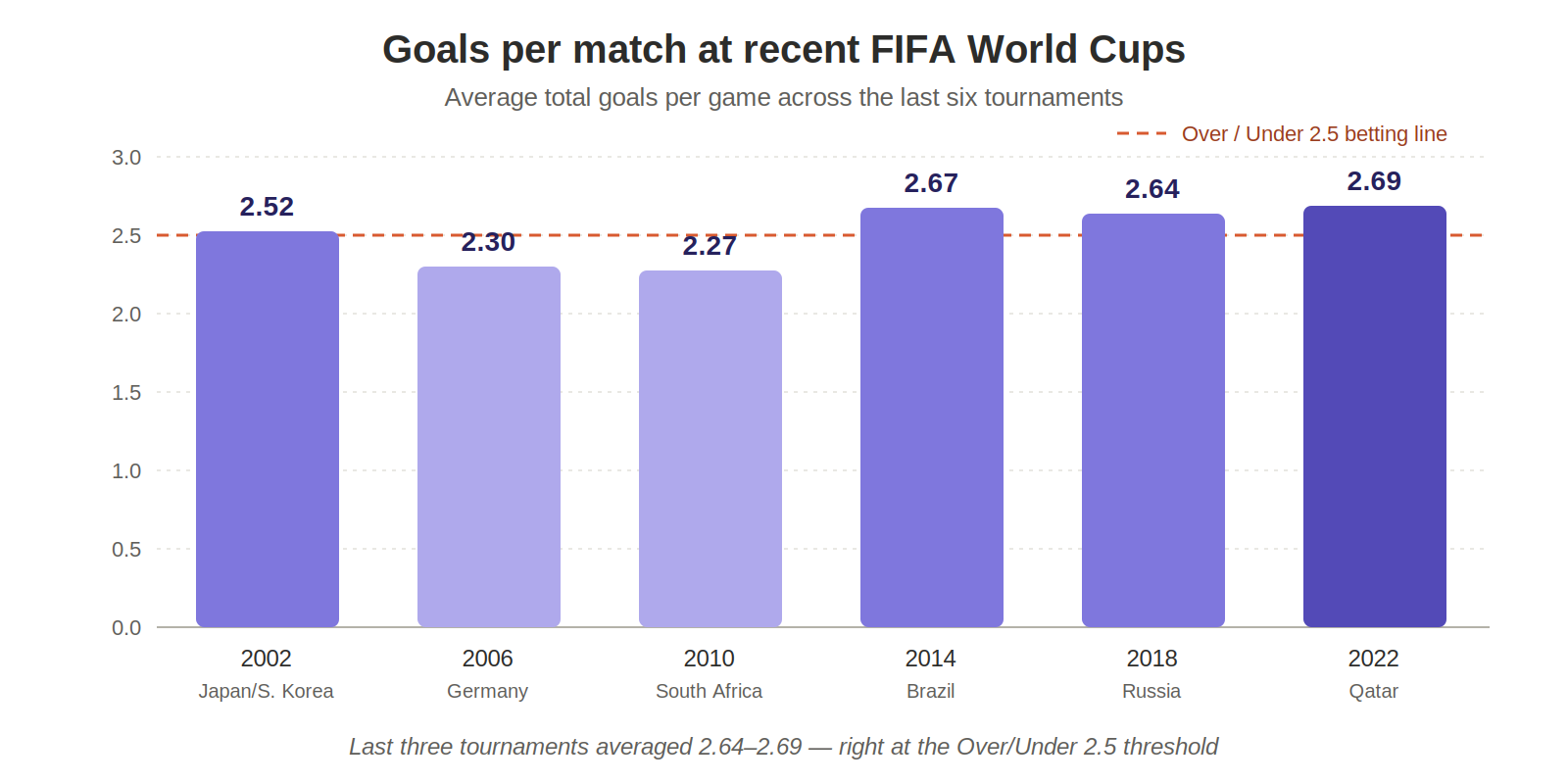
It is important to look beyond the average. Some matches are dense and defensive, others open and attacking. The best bets come from recognising that difference, not from blindly following the average.
| World Cup | Matches | Goals | Average |
|---|---|---|---|
| Qatar 2022 | 64 | 172 | 2,69 |
| Russia 2018 | 64 | 169 | 2,64 |
| Brazil 2014 | 64 | 171 | 2,67 |
| PAR 2010 | 64 | 145 | 2,27 |
| Germany 2006 | 64 | 147 | 2,30 |
| Japan/South Korea 2002 | 64 | 161 | 2,52 |
Detailed official statistics can be found via the World Cup archive.
Groups and play-offs
The number of goals changes significantly as you move between rounds. The first group matches are the most cautious, with an average of 2.38 in Russia 2018. The second opens up more as teams feel the pressure on the result.
In the play-offs, the risk increases, so coaches' choices become more defensive. A mistake here can end the tournament, so the market for fewer goals has historically been better. this trend is likely to be repeated in the round of 32 in 2026.
impact of the 48-team format
The expanded format works both ways. First of all, large margins (e.g. Brazil v Haiti) can breed one-sided matches with lots of goals. This benefits more positions.
Secondly, the new third-place classification rules allow some teams to play for a draw and save their strength. This creates more cautious match scenarios with lower scores. It is worth looking at each match individually rather than applying one strategy for the whole tournament.
Strategies for the 2026 World Cup
A clear plan makes over/under betting more attractive and saves the bank. Below are six practical strategies based on tournament statistical models.
Under 2.5 in the first group match
The opening matches of the World Cup tend to be tense because nobody wants to start with a loss. The coaches focus on a strong defence and the teams have not yet played their hearts out.
As a result, matches between teams of a similar level often end with a low score. In such moments, less than 2.5 often works, especially when the bookmaker's odds seem inappropriately high.
More 2.5 in the second group match
The second round of the group stage is usually more open. Teams have got used to the rhythm of the tournament and after the first results there is a clear pressure to score points.
This is a natural more market window. It's a particularly good moment if a team has lost its first game – it needs to attack and take risks, which often leads to a few goals.
Team goal totals in unequal matches
When a strong team meets a much weaker one, bookmakers often offer a limit of 3.5 or even 4.5. Such odds are difficult to predict because you don't know if the outsider will make any headway.
A simpler alternative is to bet only on the favourite. Germany's “more 2.5 individual goals” is often a better option than trying to guess the total for the whole match.
For this strategy, it is important that the platform offers individual team totals, not just the match total. Ybets opens team totals for all World Cup matches, including Asian handicap lines
Fewer are undervalued in the play-offs
Ordinary punters like to bet on more because they want to see goals. This creates a systematic distortion in the market – less selections in the play-offs are often slightly undervalued.
In tight 32-goal or 16-goal duels between teams of similar strength, less 2.5 often offers real value. The pressure to be right outweighs the desire to attack.
Venue and weather conditions
In North America in 2026, conditions vary widely. Mexico City is about 2,240 m above sea level – the altitude limits the pace and the flow of goals in the second half.
The heat in Dallas and Houston in June and July can significantly reduce the intensity of the second period. A cooler Seattle or Toronto, on the other hand, is more likely to maintain the same energy throughout the entire 90 minutes. These factors are rarely priced correctly by the bookmaker.
Live betting after a scoreless first half
If you go in at the break with a 0-0 scoreline, it doesn't mean it's a close game. The coaches make changes and the pressure mounts on both sides.
In-play over 1.5 second period market in such moments often has value.
World Cup group corners 2026
the 2026 format has 12 groups of four teams. Some bring together aggressive favourites, others defensive-style teams, so the more/less perspectives differ.
| Group | Main duel | More/less angle |
|---|---|---|
| A | Mexico v Ecuador | Mexico City's altitude often results in a slower second half. |
| B | Canada v South Korea | The energy of the hosts in Toronto can push them into more sides. |
| C | USA v Panama | The hosts will be looking for an impressive start, intensity is high. |
| D | Brazil v New Zealand | Strong imbalance, best to bet on Brazil's individual total. |
| E | France v Nigeria | Strong defensive structure favours fewer selections. |
| F | Spain v Morocco | Spain dominates the ball but scores are generally controlled and low. |
| G | England v Norway | England's opening matches have historically tended to under 2.5. |
| H | Argentina v Egypt | Messi unlocks defences, favours more sides. |
| I | Portugal v Vietnam | Attacking formation, 2.5 line almost guaranteed to be crossed. |
| J | Germany v Japan | Open defence and strong attack – lots of goals likely. |
| K | Belgium v Chile | Mix of experienced and young – the result is hard to predict. |
| L | Netherlands v Ghana | The Dutch attacking style often lifts the total. |
The most common mistakes when betting on the goal total
Over/under bets seem simple, but frequent mistakes reduce their profitability. Here's what to look out for to prevent the tournament from becoming an unnecessary ordeal.
- Forget that only 90 minutes plus added time counts and overtime does not.
- Automatically choose more, even though less often has better long-term value.
- To rely only on club league statistics, ignoring international football averages.
- Expect basketball results in unequal matches – some weaker teams close well.
- Ignore the type of group stage – the first and third matches are played completely differently.
- Ignore weather conditions, especially heat and altitude, which change the pace of the game.
More/less against other markets
To understand when a goal total is optimal, it is useful to compare it with other popular markets. The table below shows the main differences.
| More/less | 1X2 | Both will score | Exact score | |
|---|---|---|---|---|
| Main goal | To guess the total number of goals | Predict the winner of the match | Whether both teams will score | Predict the exact score |
| Winning condition | Total sum is compared to the line | A, B or draw | Both must score at least one | Exact number |
| Maximum advantage | No need to guess the winner | Simple and traditional | Interesting until the last minute | High odds |
| Major risk | Late goal spoils the bet | Reds or surprises | One team fails to score | Very low scoring |
| Preferred | For statistics-based analysis | For clear favourites | For games with weak defences | For small fun bets |
Where to bet more/less in the World Cup
The choice of platform has a big impact on how convenient it is to bet on goal totals. Different bookmakers offer different lines, variable odds and Asian variants, so it's worth comparing a few. For more information on proven operators, check out our Best betting companies review.
Fans of faster payouts and cryptocurrencies may want to consider alternatives. Such operators often offer wider Asian handicap markets, so the best crypto betting sites are suitable for experienced bettors who bet more frequently.
Responsible betting during a tournament
The World Cup lasts almost a month and matches are played almost every day. This pace increases the risk of chasing losses or betting just for fun.
Set a deposit limit for the whole tournament before the first whistle. Clear responsible gambling sistema with session timers and reality messages helps you stay disciplined.
A summary of over/under betting
Over/under betting on the 2026 World Cup is one of the most data-driven markets – you can model, compare against historical averages and avoid guessing the winner. with 104 matches, multiple cities and format innovations, there are more opportunities to find value than in any previous tournament.
Start with an average of 2.5-2.7 goals as a starting point. Pay attention to the match context, stage and weather conditions, and don't ignore less – that's where value tends to lie in major tournaments.
FAQs on over/under betting at the World Cup
What is over/under betting
This is a market where you bet on whether the match statistics (usually the total number of goals) will be higher or lower than the number set by the bookmaker. There is no need to predict the winner, only the total score.
How over/under works in football
The bookmaker sets a line, for example 2.5 goals. More wins with 3 or more goals, less wins with 2 or less. A limb of 0.5 guarantees that the bet will have a clear result.
Does the over/under count as extra time
The standard over/under markets only include the main 90 minutes plus added time. Overtime or penalty shootout goals do not count towards the result.
What is the average number of World Cup goals
The historical average is around 2.6-2.7 goals per game. International matches tend to be denser than club leagues, so the 2.5 line becomes the main reference point.
More or less profitable at the World Cup
Less is often more profitable in the long term due to the public bias towards more sides. Bookmakers usually put a smaller margin on the more odds because that's where the inexperienced punters' money floods in.
What is the Asian handicap
It is a version of over/under betting with integer (e.g. 2.0) or quarter limits (2.25). If the number of goals scored in a match matches the whole line, the bet is returned.
Can you bet on individual team goals
Yes, you can only bet on goals scored by one team. This is a good strategy when the favourite is playing a much weaker opponent and the total for the match looks uncertain.
How to bet more/less live in a World Cup match
In-play over/under allows you to change positions depending on the result of a break or the fatigue of the players. The most popular window is after a 0:0 break, when the odds of 1.5 more in the second leg are often attractive.